

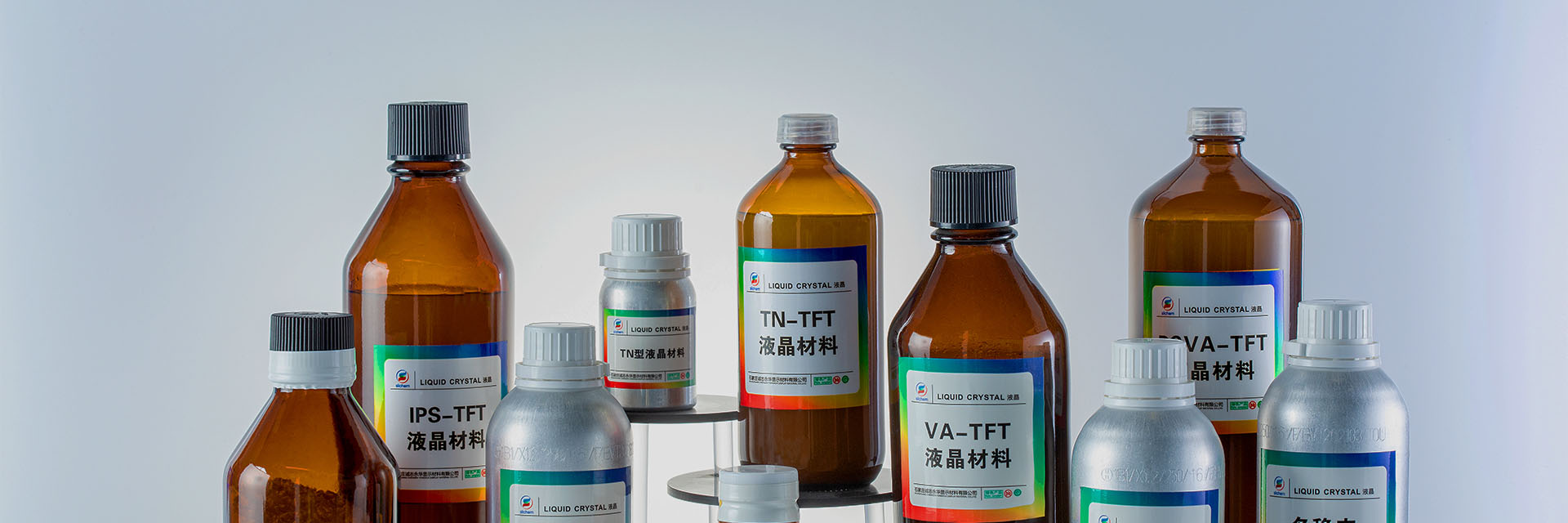

When dimming is no longer just about "fog white" - the era of dye liquid crystal PDLC is coming
Release time:2025-11-26
Page views:128
With the rapid upgrading of intelligent light-control materials, people are no longer satisfied with the two monotonous dimming effects of "transparent/frosted white". The market demands higher privacy, stronger visual performance and richer design languages. Thus, dye liquid crystal PDLC is quietly emerging as a new focus in the industry.
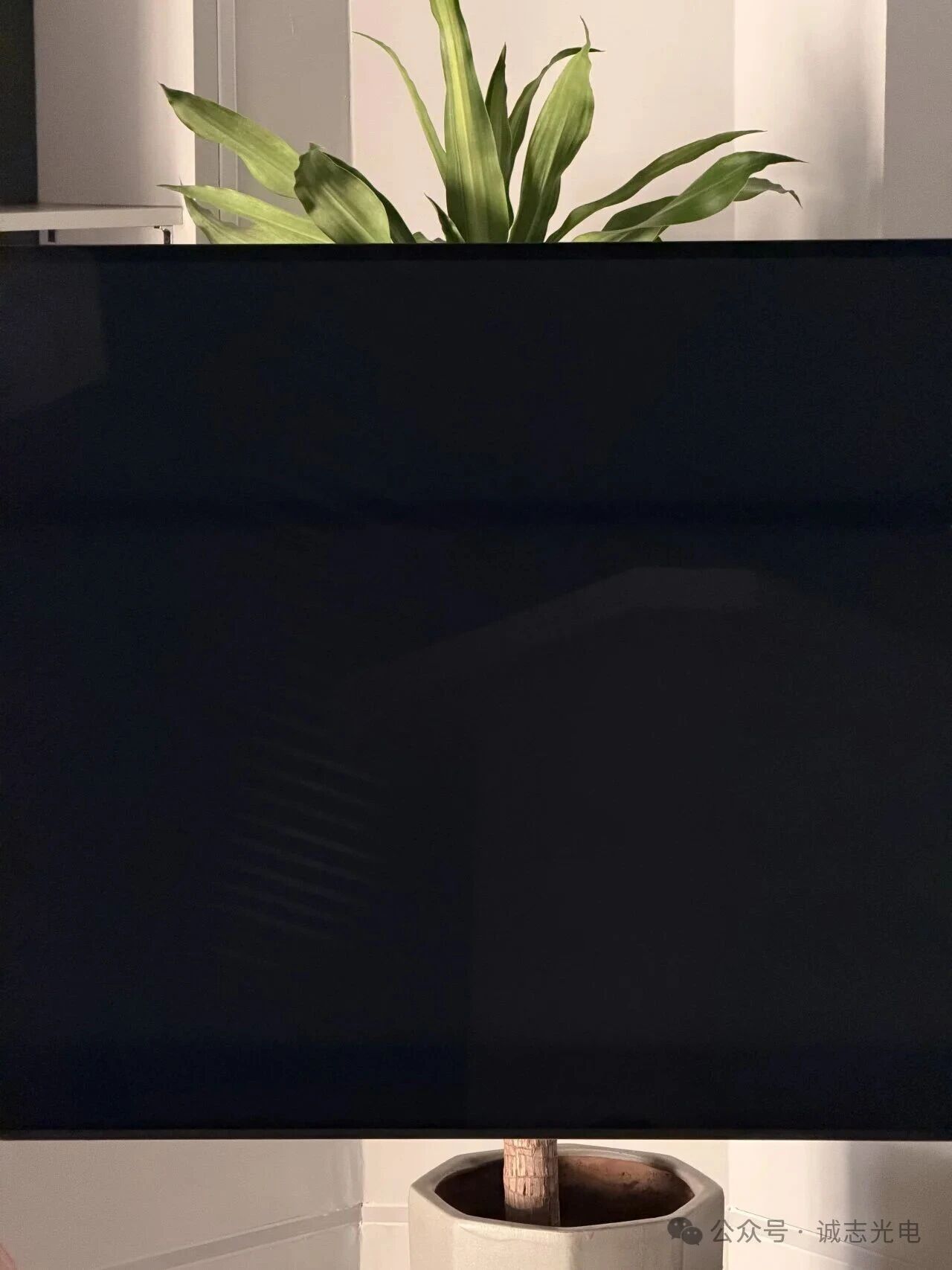
Power Off State
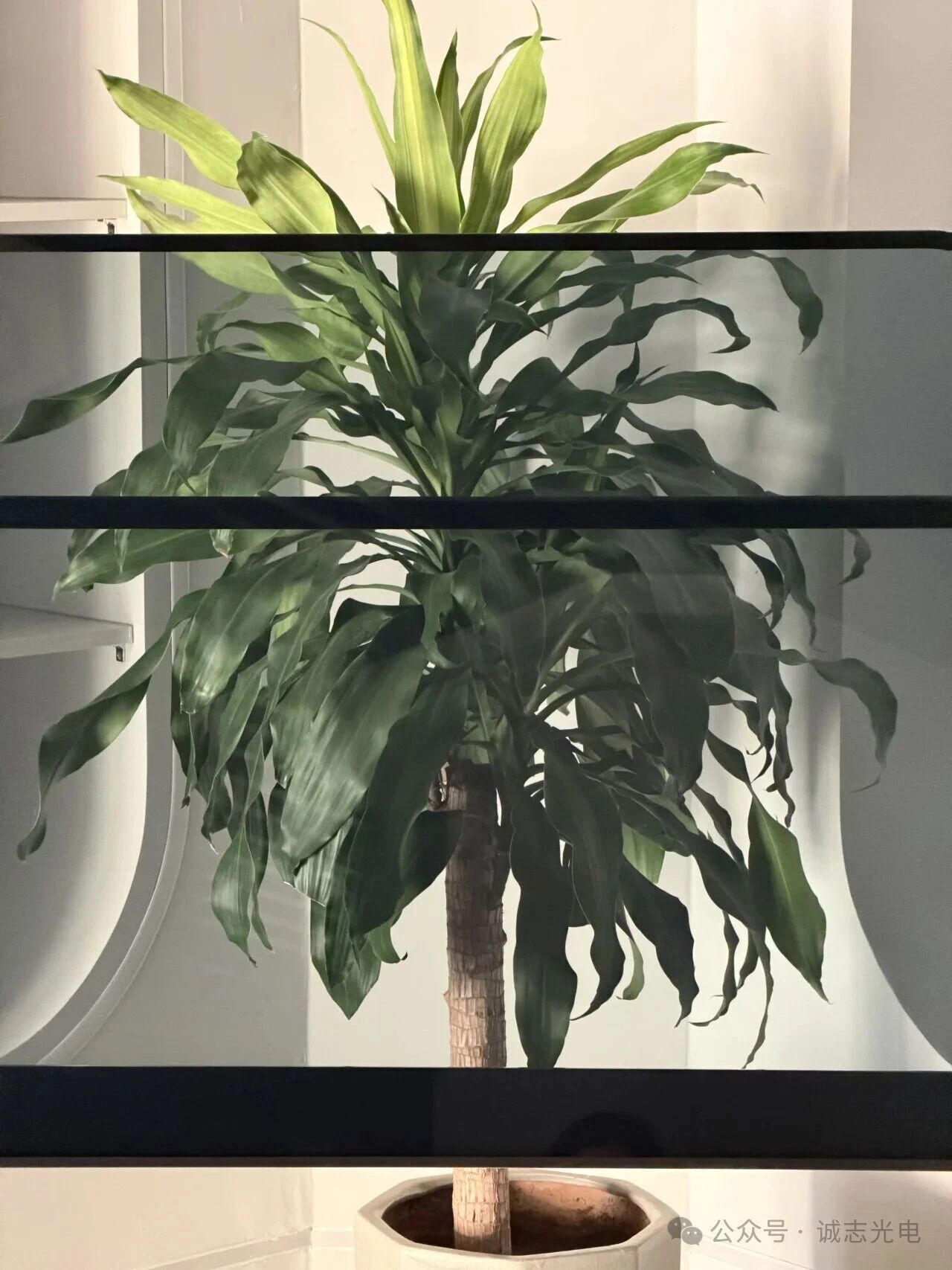
Power On State
1. Why are traditional PDLC facing bottlenecks?
Over the past decade, PDLC dimming films have enabled glass to realize space switching and privacy control with two states of "transparent when powered on and frosted when powered off", quickly gaining popularity in architectural, household and office scenarios.
But now, its limitations have become increasingly obvious:
Single color: No matter how high-end the occasion is, frosted white is always the only "off state".
Insufficient aesthetic expression: High-end spaces pursue deeper atmosphere and softer brightness adjustment.
In contrast, the experience brought by dye liquid crystal PDLC is an upgrade from two dimensions to three dimensions.
2. What is dye liquid crystal PDLC and what pain points does it solve?
Essentially, dye liquid crystal PDLC introduces dichroic dyes into liquid crystal droplets. The dyes change with the alignment direction of liquid crystals, thus achieving dual regulation of light scattering and light absorption.
This upgrade brings several qualitative changes:
Controllable color: The off state is no longer a single milky white, but can realize various styles such as gray and deep black.
Significantly improved privacy: The superposition of absorption and scattering makes the dark state "darker" and truly invisible.
Customizable design: It can integrate infrared absorbing dyes to achieve heat insulation, energy saving and other functions.
Therefore, on the basis of intelligent dimming, dye liquid crystal PDLC is more like "a functional film material with electrically controllable color change" — opening up broader imagination for designers, automakers and architects.
3. Why will dye liquid crystal PDLC usher in an outbreak in the next few years?
We have observed several industry trends converging at an accelerated pace:
Trend 1: The demand for privacy and ambient optics in new energy vehicles is surging. Car roofs, windows, projection screens and HUD are all developing towards dimmability, and black/gray dimming films are more in line with the in-car atmosphere.
Trend 2: The demand for "variable dark glass" in high-end buildings is rising. Hotels, villas and clubs are more eager to balance design texture on the basis of privacy.
Trend 3: The technical maturity of the industry is improving. New dye systems, polymer systems and electrode structures reduce costs and extend service life.
Dye liquid crystal PDLC is no longer a laboratory toy, but a scalable new light-control material.
4. What are the core difficulties of dye liquid crystal PDLC?
Core difficulty: The reliability of dichroic dyes needs to be improved.
To absorb visible light, such molecules generally have a high-conjugated structure, which leads to a substantial increase in ultraviolet absorption while absorbing visible light. After absorbing ultraviolet light, molecules undergo energy level transition; in this excited state, molecules are prone to chemical reactions that damage their structure, thereby affecting the color and contrast ratio of dyes. In addition, azo dyes will undergo photoisomerization under ultraviolet/visible light irradiation, leading to unintended changes in color and dichroic ratio.
5. Why did we decide to lay out this track?
As an enterprise focusing on optoelectronic materials and liquid crystal technology for a long time, we have observed that market demand has upgraded from "dimmable" to "dimmable + color-tunable + high privacy + aesthetic design". High-end architecture, automotive and consumer electronics industries are rapidly adopting electrically controlled dark films, but the industry lacks stable and scalable dye liquid crystal PDLC products. Based on this, we decided to fully launch the R&D and industrialization of dye liquid crystal PDLC technology.
Our goal is not simply to make "colorful PDLC", but to build a new generation of variable optical density film material platform.
6. What new possibilities will it bring?
In the future, dye liquid crystal PDLC will enter more real-life scenarios:
Vehicle-mounted intelligent sunroofs and privacy side windows: Dark off state + highly transparent state → more suitable for in-car atmosphere and privacy protection.
High-end building curtain walls and meeting room glass: Can be made into "gray frosted glass", offering greater freedom in space design.
7. Conclusion
From frosted white to multi-color, intelligent light-control materials are ushering in a new leap forward.
When users are willing to pay for better privacy, better light perception and higher-level space experience, dye liquid crystal PDLC is no longer a niche technology but a major trend. The future will be a critical stage for dye liquid crystal PDLC to move from technology introduction to commercial outbreak. Chengzhi Optoelectronics will continue to deepen its layout in this track and provide more mature, stable and design-flexible light-control solutions.
Welcome industry partners to exchange and cooperate to jointly explore the infinite possibilities of dye liquid crystal PDLC!






Chengzhi Yonghua
Official Account


